Network Technology
Multidata began operations with a communication network specialized in the transmission and commutation of Data, and for this purpose Multidata was awarded the respective licenses by CONATEL.
The technology chosen by Multidata as transport was ATM, in concordance with the network used by EQUANT, and in compliance with the equipment used by the world’s biggest providers for these types of services.
3.1
Multidata’s Central Network: Backbone
In its back-bone Multidata has developed a network formed by three independent and interconnected between them, these are: Multiservice Networking, based solely in the last generation of MPLS technology with the trademark CISCO; the SDH Network based solely on the Sinchronized Digital Hierarchy by the brands Netring and Alcatel; and the ATM/FR network based solely on the Asyncronous Tranfer Mode technology from Nortel.
This type of back-bone infrastructure has allowed MULTIDATA to develop an extremely reliable network heart, and to tend the necessities of the local and international market.
3.2 SDH Network
In June/ 2002 Multidata became the only private company with Data Services, that also has its own intercity infrastructure, making it possible to install and put in service an SDH Network between the cities of Tegucigalpa and Puerto Cortes with a final capacity of 4x155Mbps which allows us to offer a range of services including the E1 all the way to STM-1 in all the central corridor of the country and adjacent cities, that receive our Data and Internet services.
One of the most important characteristics of the SDH Networks is that it allows a very high availability, having the ability to detect when one route is damaged o offline, at that moment; it is able to decide to turn all its traffic through an alternate route o a backup route.
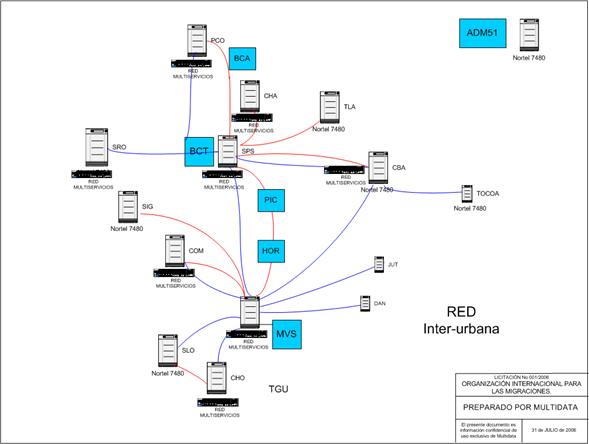
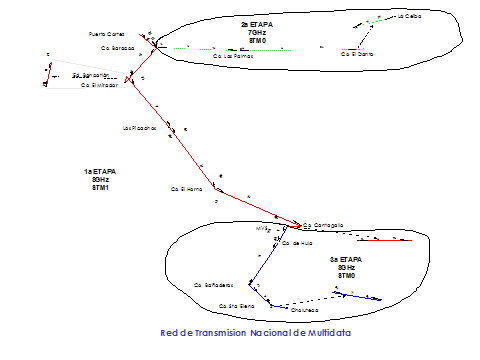
In the following illustrations, we show you the connections through Multidata’s own network and using Hondutel’s networks as a backup. In the illustration “Diagrama con Capacidades de Conexión” (Connection Capacities Diagram) you can observe Multidata’s network configuration, to allow the existence of redundant routes. Same that makes it possible to establish connections through private networks.
In the intercity connection to the city of La Ceiba, as shown in the figure before, of Multidata’s transmission network, we can see that this has already been implemented since last February. With this connection Multidata became the first company with its own high capacity high trust ability network to connect the city of La Ceiba. La Ceiba is still connected to Tegucigalpa through other physical routes with Hondutel, for redundancy effect.
The configuration of this intercity network has allowed Multidata to have networks that in their back-bone has the proven availability superior to 99.99%, even when using Hondutel’s intercity links, due to the fact that the use of this intercity links has reduced through the establishment of redundant links and that the equipment that operate this nodes have the intelligence to decide the traffic through other active routes in case of failing routes.
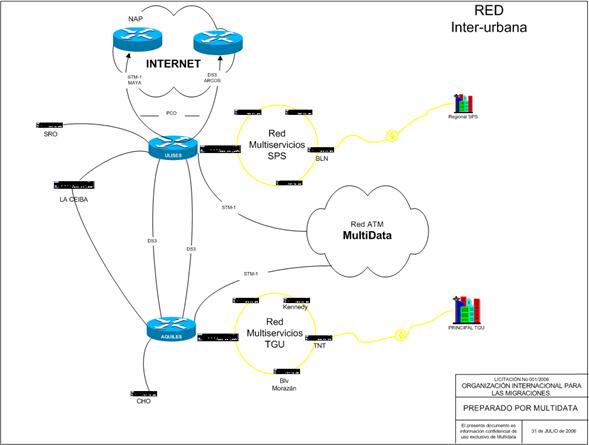
It is important to mention, that in cases where we do not have our own network, Multidata has established a configuration method to install a node, after having the channels with Hondutel, and this allows us the direct control of all the clients and to determine in an immediate manner when the interconnection capacity fails.
In addtion to the point illustrated above, we can observe in the next set of figures that Multidata has already implemented local SDH networks, in Tegucigalpa, San Pedro Sula, Puerto Cortes and La Ceiba.
These SDH technology based rings, allow us to provide local availability of the nearby services at 100%, since the moment a failure occurs in one route, the service reestablishes itself through another active direction in the ring and using the equipments intelligence to detect failed routes and active ones.
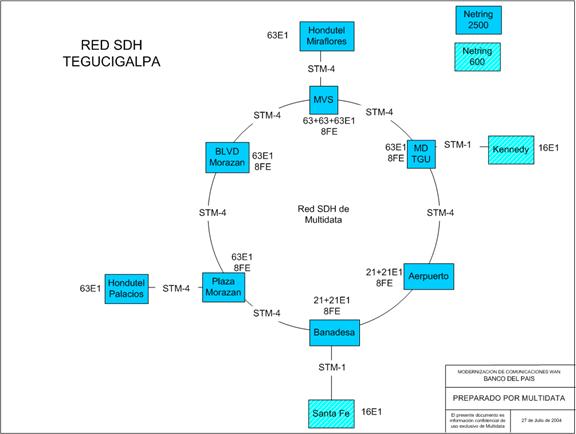
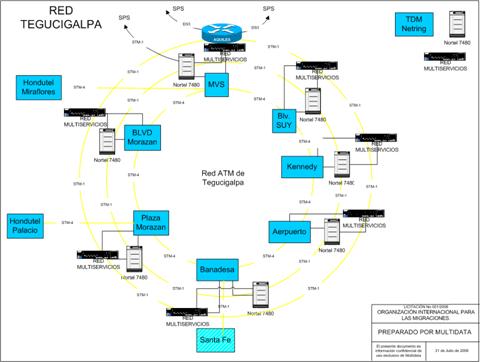
The local SDH Network in Tegucigalpa has been designed to provide the best coverage in the whole city, also connecting the principal points in Hondutel’s network in Tegucigalpa. The connections to Hondutel have redundancy through two physical and separate routes with fiber optics.
It is easy to see that some nodes, like Santa Fe are not in ring, the redundant routes for these nodes are built through microwave links in 10.5 GHz frequency, and through fibers that end up at the same node, but with different and separate physical routes.
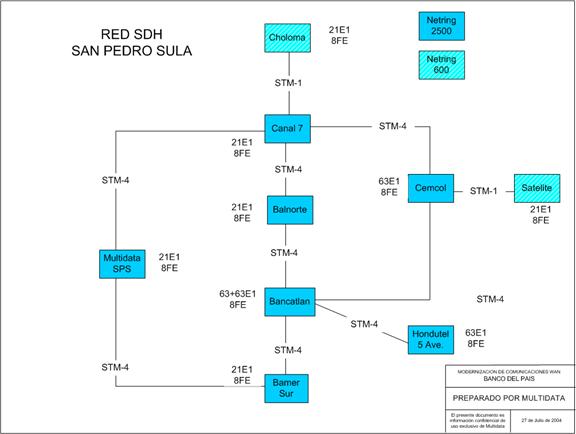
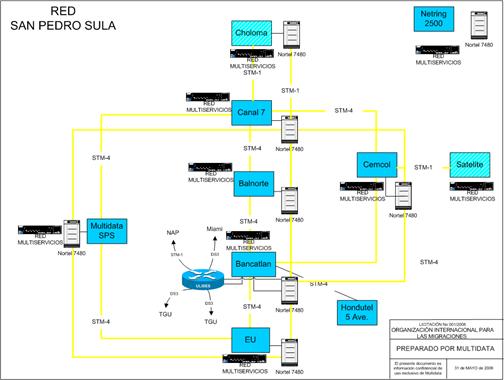
San Pedro Sula’s network design, has allowed the establishment of multiple redundant routes by establishing two fiber optic rings. This guarantees that between two nodes a three route redundancy exists.
It’s important to also note that for the nodes in Hondutel and Satellite, we have established two route redundancies, in the case of Hondutel SPS, we have an additional fiber optics route physically different than the main route, in the satellite node, and the redundancy is accomplished through microwave links at 10.5 GHz frequency.
The node in Choloma has actually three routes, the main route which is shown in the in the diagram, and two redundant routes, one through microwave at 10.5 GHz and the other through channels acquired in Hondutel.
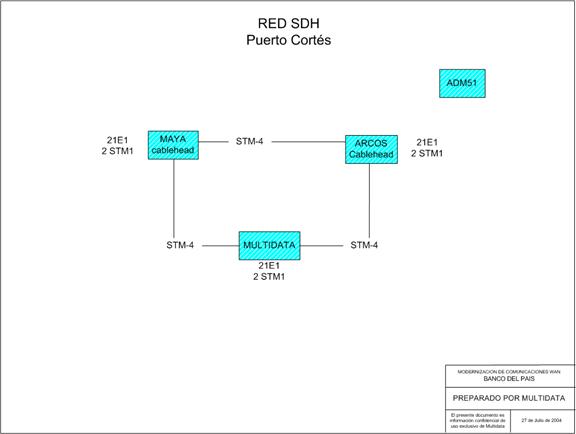
As mentioned before, the Puerto Cortes network is very important to the Internet services, due to the fact that this city is the city where two of the most important submarine cables are available and operational; these connect North America with Central and South America, named Submarine Cable MAYA-1 and Submarine Cable ARCOS.
Multidata has its own equipment on both stations of the submarine cable. This has been achieved through the construction of a fiber optics network that connects the cable-heads with each other and each one of them with equipment installed by Multidata in separate places.
Another important city in data services is the city of La Ceiba, in the figure shown next we can observe the SDH Network configuration that has been implemented in this city.
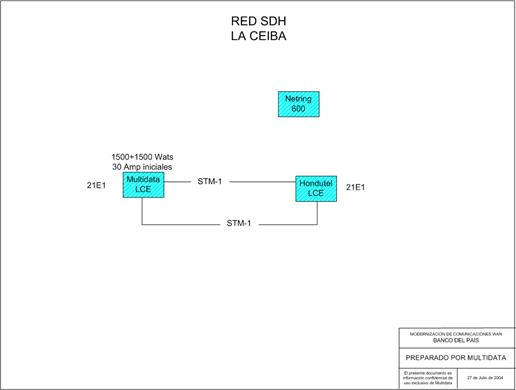
The network installed in La Ceiba is relatively small, its intercity network, as mentioned before, is protected through a physical redundant route provided by Hondutel.
This diversity of routes, to La Ceiba has the particular importance for the whole network, especially between the cities of Tegucigalpa and San Pedro, that is, that it is capable of providing additional redundancy between Tegucigalpa and San Pedro Sula.
3.3 Multiservice Solutions (MPLS)
MULTIDATA has developed during the last two years a Metro Ethernet network, using MPLS technology, which purpose is to deliver IP technology based services at high velocity and with great availability; in addition, last year, Multidata has displayed a wide range of fiber optic network (inside the project named FTC, fiber to customer) to be able to deliver in a fast and reliable way, fiber optic circuits in speeds up to 1 Gbps, 100 Mbps y 10 Mbps, in the principal cities of the country; This has allowed us to be the first to supply to our customers, services with interfaces up to 1 Gbps.
All of this has allowed us to establish during 2005, 2006 and 2007, clients with WAN Networks at high velocity, with equipment optimization and routing and connection resources. During 2007 this network underwent an expansion process with the objective of improving the availability of the back-bone and the diversification of products and services, that in this line, will be delivered to our clients.
It’s important to mention, that this multiservice network, has his own connections, with this what we want to explain is that direct interconnections at levels of 100 Mbps and 1 Gbps through optic ports, directly to the fibers.
In the back-bone diagrams presented before the connections between networks of diverse technologies can be easily observed, that is why the MPLS backbone, has physic and logic backup routes through the SDH platform and it also uses the ATM platform as an additional route.
We have achieved that each node has a minimum of three routes of interconnection, administered and automatically available in case of failure in any of the other connections, accessing the traffic route in a transparent manner to our customers. It is more important yet to specify that these intercity routes, this philosophy is also applied by Multidata, and it is so that in the connections to the central corridor Multidata maintains three backup routes active, two in fiber optic ( one underground and another aerial) plus another route via microwave.
In particular the Hig Speed MPLS solutions, are characterized by delivering to the port IP solutions (Internet Protocol) optimizing the configuration of the clients equipment, allowing an easier management to the redundancy configurations, and making it easier to interact with Multidata’s Network and their clients.
This MPLS multiservice has all the capacity of offering to our clients services in Level 2, or better said in Clear Channel, in IP technology, furthermore we provide services in Level 3, completely managed to our clients that require this type of products.
A succesful connection between the ATM/FR and the MPLS networks, in such a way that the coverage is not limited at any moment, being able to deliver all the data and internet services at all speeds, in all the cities en coverage zones; the services will be basically determined by the access platform that the clients choose at the moment of connection, these access platforms use physical means: like fiber optics or copper o wireless means: directly IP or Clear Channels.
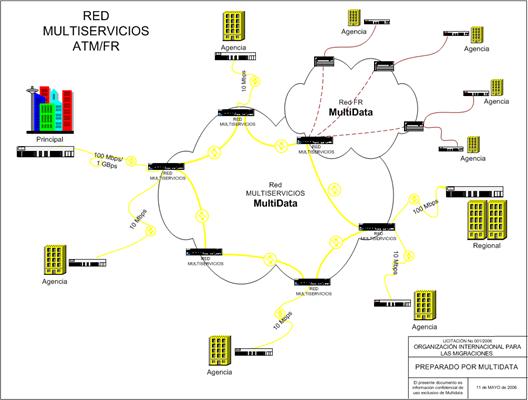
It’s important to mention that the transport from the client to the MPLS nodes is done per request of the client or depending on the required services. For speeds above 2 Mbps, the access is done through Fiber Optics, because of the effective and guaranteed communication is the best (10/100 Mbps), bandwidths that can only be guaranteed through the access of optic fiber.
3.4 ATM/FR Networks
Multidata’s Data Commutation network is based in a Nortel platform ATM Passport, the interconnections to the backbone in the urban zones are done with fiber optics and in some intercity cases via our own transmission network or via Hondutel.
One of the greater advantages of the ATM Network is its capacity to transport in a very transparent way any protocol, allowing this network to deliver IP services, Frame Relay, HDLC, etcetera; to all our clients. It is good to mention that various rings have been created between Multidata’s own network and the hired capacities from Hondutel, which allows that the services are permanently active, an occurrence of failed communications in any of the routes that exist in the ring.
The ATM switches have the capacity to determine when a route has encountered problems or to re-route the traffic through any of the still active routes.
This improves the quality of the services allowing them to be delivered with high availability and high trust ability.
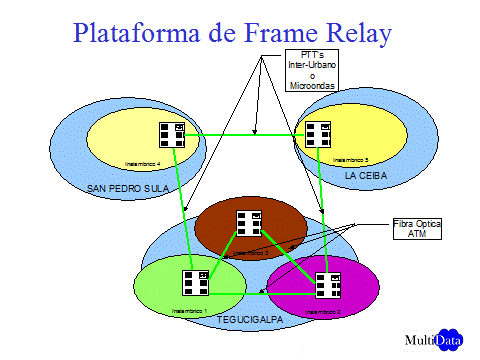
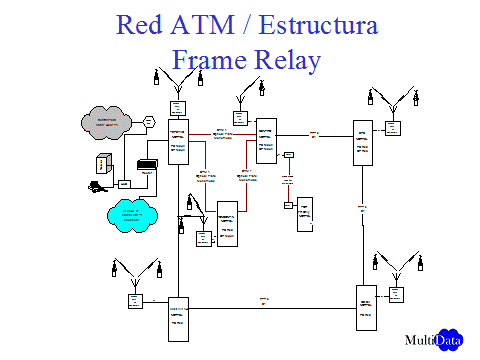
Multidata has taken the determination to form very safe and trustable networks, this can be observed in the graphics shown above, where the ATM networks are shown in the cities of Tegucigalpa and San Pedro Sula.
In these figure below you can see that these are built in Rings, it is shown directly in the ATM Network as in its connections to the SDH Network. Both networks are capable of determining if a failure has occurred in any of the connection routes, and also have the capability of re-routing the traffic through the route or routes that are active.
3.5 Frame Relay Networks
As main Access protocol Frame Relay is used, which has characteristics that can be taken advantage, and have positioned it as the most used protocol worlwide, we can mention some:
Guarantee that data will not be violated
Bandwidth via CIR.
Burst traffic guaranteed via EIR.
Simplicity in communication using multiple PVC in a single port
Automatic Back Up in case any problems via SPVC’s
Interconnection with worldwide Frame Relay coverage
Network design according to the customers’ necessities, CIR speeds range from 2Mbps to 8mbps in Frame Relay.
We must emphasize that the Frame Relay Transport and service delivery platform, works directly at a physical level, which makes it a very secure and impenetrable platform from external points to the network. This particular characteristic, is what today, gives it its preference among many financial institutions worldwide. In contrast to IP technologies, which in case have already become safer networks, in Frame Relay technology the clients don’t pay much attention the security aspects between the provider’s network and their own.
In a similar way, the networks created for the clients are completely private from the other clients’ networks, allowing the creation of private networks, independent and exclusive to each client.
3.6 Clear Channels
Through any of the SDH platforms, local or intercity we can create clear channel connections for each client’s specific request.
Last generation equipment, like Nortel Passport, also allow the use of protocols and “legacy” services inside each clear channel properly defined through any point in the network.
Internet Networks (IP)
As an alternate service for data transfer through MPLS, ATM and Frame Relay, Multidata also provides Internet Networks (IP) where we have implemented CISCO’s latest technology.
Using an IP Network, Multidata has the capacity to deliver Internet Connection Services directly through IP Protocol.
